A simple $5 local outdoor fair find is easily transformed into a delightful theme bag.
I love handbags so much that you could say that I am a handbag addict. Divided into three categories, I have accumulated about 100 bags thus far.
I have original Coach leather bags, collectible Arcadia patent leather imprinted bags, and a group of miscellaneous brand bags that were gifted or given to me.
Acquisitions
To my credit, I acquire only second hand/collectible bags, new bags purchased at a deep sale price, no cost ‘pantry’ donation bags, and gifts. This collection process has taken several decades so far.
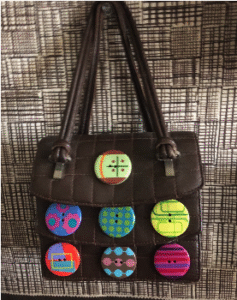
Handbag with button decor.
Thanks Mom
The handbag to the left belonged to my mother. In fact, the only purchases I had to make were the buttons bought to decorate it. Actually, I love the buttons so much that I feel they transform the look of this bag from something boring to something much more fun.
As a matter of fact, most of my creations are fun because I tend to use decorations that are whimsical that create something fun out of something ordinary.
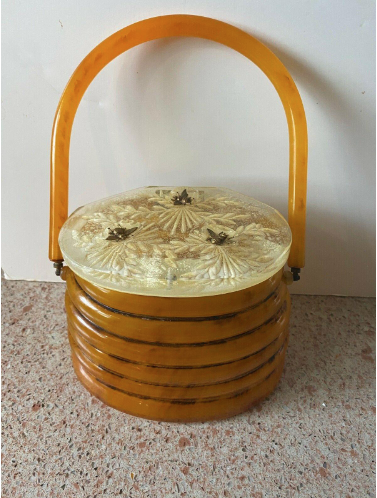
Vintage Llewellyn Lucite Beehive Purse Handbag – Great Condition, Hard to Find
OOAK
Speaking of fun, I think that this OOAK (one-of-a-kind) bee hive shaped bag from that popular mid-twentieth century period is the best lucite bag ever created.
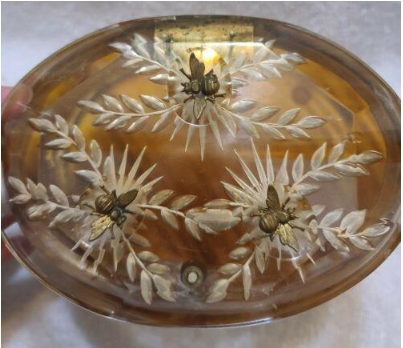
I have never even seen one for sale or one in person. In fact, all the proof I have of its existence is this picture of it. In addition, the original design is already decorated. It has three dimensional bees made out of metal secured on the top of the beehive so it needs no input from me.
top of beehive purse made by Llewellyn
My Favorite Purse
To its credit, this bag is truly ingenious with exquisite craftsmanship. In fact it is my favorite pocketbook of all time.
As a result, it needs no additional decoration to enhance it. Because of all these qualities, I feel that it really belongs in a museum.(1)
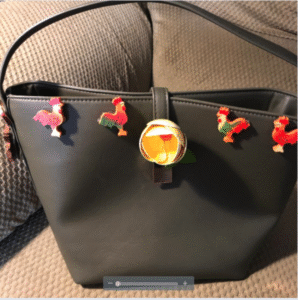
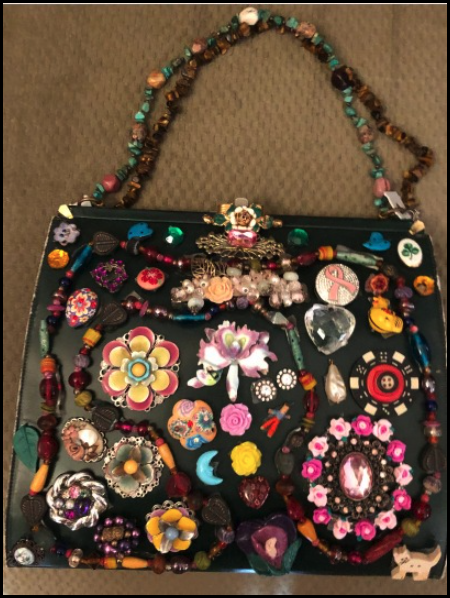
A hunter green decorated Saks Fifth Avenue leather purse
Mom Outdid Herself
Here is another purse that belonged to my mother. Actually it was from Saks Fifth Avenue and I think I was with her when she bought it over a half century ago.
But instead of a fun decorative pattern, I made it look glamorous even regal. In contrast to most of the bags I have decorated, this one took a very long time to complete.
Finale
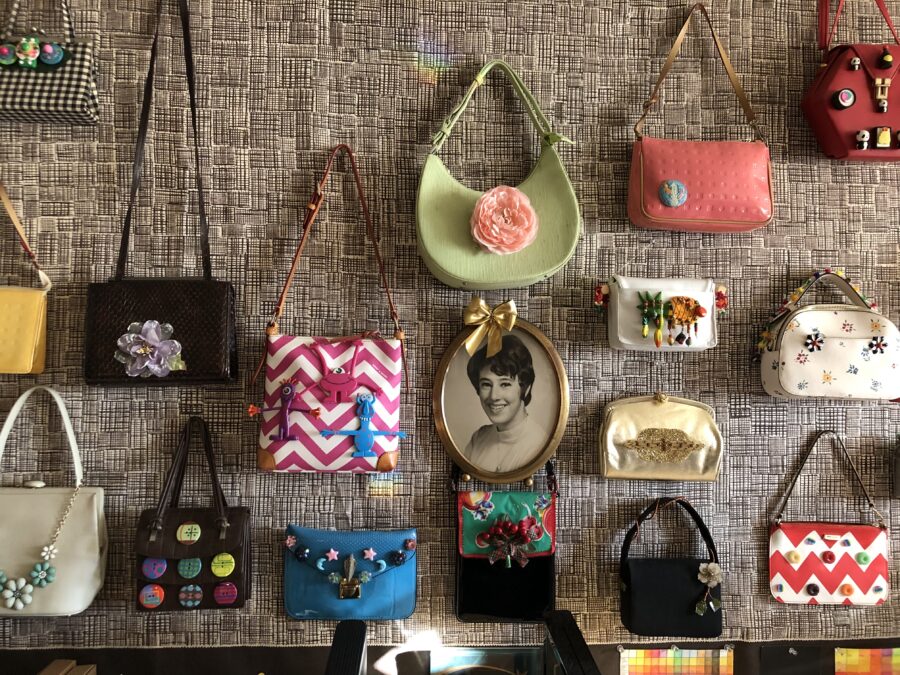
Only a fraction of my handbags are decorated and visible. Therefore, only a few can be displayed at one time. But in total, it seems like there are purses every where in my apartment. Some are on shelves in dust bags. Others are waiting on the assembly line for decorating. Lastly is the the finale of displayed decorated bags is the wall behind my desk. Here they are. A variety of bags on the wall for displaying.
Here are two licensed design artists whose work I love.
Their licensed designs are based on their illustration and writing projects sold to product manufacturers. By name, they are Mary Engelbreit and Susan Branch. In fact, you may likely be familiar with their work. If so, that would be from both their prolific past work and present activities as well. As I mentioned, from their start I have loved and continue to love their work.
A brand is the means by which an entity is recognized across the board. The brand itself can be visual or verbal material. The entity can be a person, product or company as well. In fact, the brand can be the work of the designer him or herself.
In the cases of both Mary Engelbreit and Susan Branch, their design media that lead to their work being licensed was primarily their illustration and writing skills. For example, Mary Engelbreit’s licensed designs include greeting cards, books, and kitchen accessory designs.
Similarly, Susan Branch’s licensed designs actually also includes books, calendars, fabric and wallpaper patterns. In other words, all kinds of kitchen and eating accessories. After all that, Susan is also a cook and recipe writer. Otherwise, their work runs along very similar lines at times. But they still have unique, distinct styles.
Opening of the New York Coliseum.org
My Story
In addition to admiring their successes, I yearned to become a licensed designer too. Actually, it was during the time I was doing my own illustration work. My work was making personal greeting cards for friends and family. After that, I tried my hand at commercial cards. However brand design was not meant to be for me. In conclusion, I did have the opportunity to have my work published. In fact, I did have a small portion of success at commercially available cards.
My Published Work This is a simple story. It came about as a result of my attending a class in greeting card design at the Parson School of Design in NYC. As a result, the students then received passes to the then famous Gift and Greeting Card Show at the New York Coliseum. It was the only arena of its type in NYC at the time.
@Alison Gilbert for Family Line Greeting Cards. Two cards I designed and sold to Family Line Greeting Cards. I met them at the NY Coliseum Gift & Greeting Card Show. Both cards were published and sold in an upscale gift and card shop on the upper East Side of Manhattan.
Conclusion
There I met a company called Family Line Cards. Both of my commercial greeting card sales were through their company. I may not have become a licensed designer. But above all, I did sell two greeting cards design. Therefore I am very proud of my few moments of success.
Forgotten treasure abound in our consumer based culture. Do you know what forgotten treasures are? Have you ever watched the PBS show, ‘Antiques Roadshow’? If you have, you will know that the difference between a forgotten treasure, and what is not, can be a very fine line.
Here are some questions to ask and actions to take to determine what you have, a forgotten treasure, a collectible, an antique or just a piece of furniture.
• The first thing to do is to observe what kind of condition the item is in. Is it vintage (perfect) or is it in a degree of less than perfect. That will determine what its intrinsic value is. If something is vintage, it is best to keep it as is, not do anything to it other than gently clean it, keep it or try to sell it.
If a piece is obviously damaged, then one wants to find out if it is an antique or a collectible. That involves research either online, in books or in-person. An antique is something over 75 years old. A collectible is less than that but at least 50 years old.
There was an old Queen Anne dresser on ‘Antiques Roadshow’ once that seemed to need a repainting. So the owner repainted it. But because it was an antique several hundred years old, its value was diminished significantly by the facelift. So one must be diligent in the research stage.
• The second thing to do is to look for any identifying markings. The stamp under the seat portion in the featured image of our stool reveals its origin. This piece of furniture was made by the Burke Division of the Brunswick Corporation.
I also found the above chairs on a facebook page, Retro Luxe Home that specializes in retro furniture. This manufacturer’s work clearly had some collectible value.
But in the case of the stool in this story, the damaged condition of the seat part made it far from vintage. That was the sign that it could be given a new life and reincarnated. I chose not to restore it as another artisan, Shaun Guinan of Reworks Vintage, Pittsfield, MA had done with his table and chairs. I chose to reincarnate it with my own decorative flair, instead. Here is the stool, before and after.
I want to thank my dear friend, Michelle for lending me this stool to demonstrate one of Alison*s Heirloom Projects.
So don’t forget. The next time you come across forgotten treasures, don’t pass them by. They may be old friends that just need some TLC and a new life. If you are not sure how to do it, you can refer to, ‘The 5-Step Decorative Painting Process’ on YouTube.