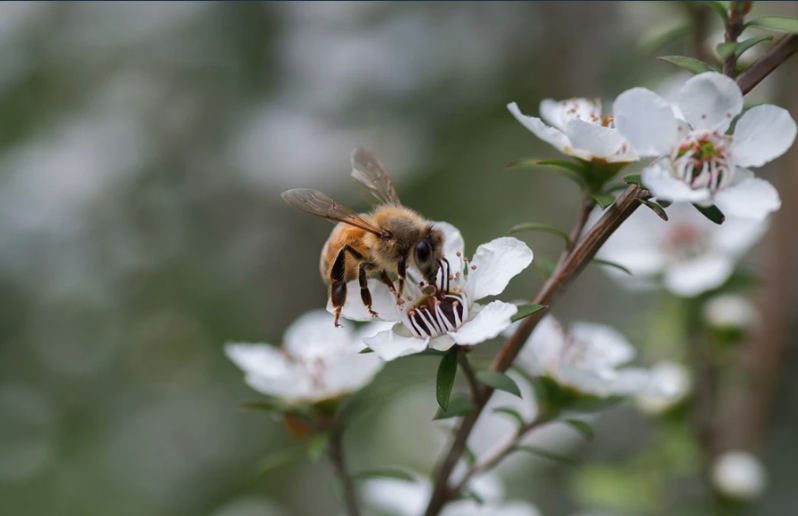
A honey bee collects pollen from the Manuka bush flower. Courtesy of Shutterstock/M Rutherford
THE MANUKA HONEY STORY
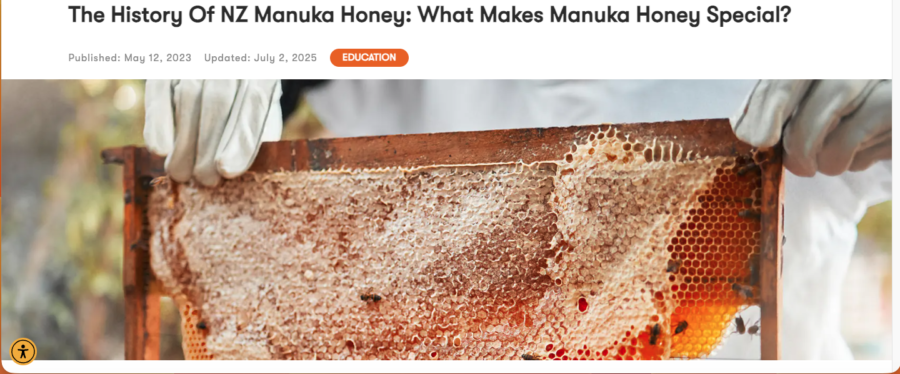
The Manuka honey story begins in 1839 when missionaries first brought honey bees to New Zealand. Māori people already treasured the native Mānuka plant for its medicinal properties. But until then, it had not been used to make honey.
What makes Manuka honey special is its high concentrations of methylglyoxal (MGO), which creates powerful antibacterial effects up to 100 times stronger than other honey varieties.
The History of NZ Manuka Honey
Unlike regular honey, Manuka honey contains stable non-peroxide antibacterial activity. Scientist Peter Molan actually discovered this in the 1980s (40 or so years ago).
Scientific research has validated Manuka honey’s special properties for treating wounds, infections, and supporting wellness (among many other uses), making it a valuable natural therapeutic option.
Strict government regulations protect the authenticity of New Zealand Manuka honey. The UMF™ grading system, ensures consumers get a genuine product with verified levels of beneficial compounds.
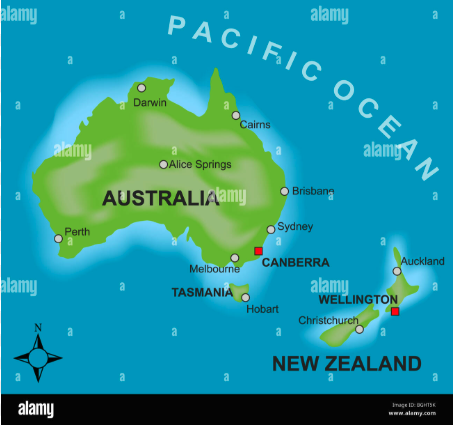
Map of Australia and New Zealand from Alamy
ORIGIN OF MANUKA HONEY
A small amount of honey from the Manuka tree is produced in Australia. But technically, it is proper to brand this type of honey as ‘Manuka honey’ only when it is produced in New Zealand.
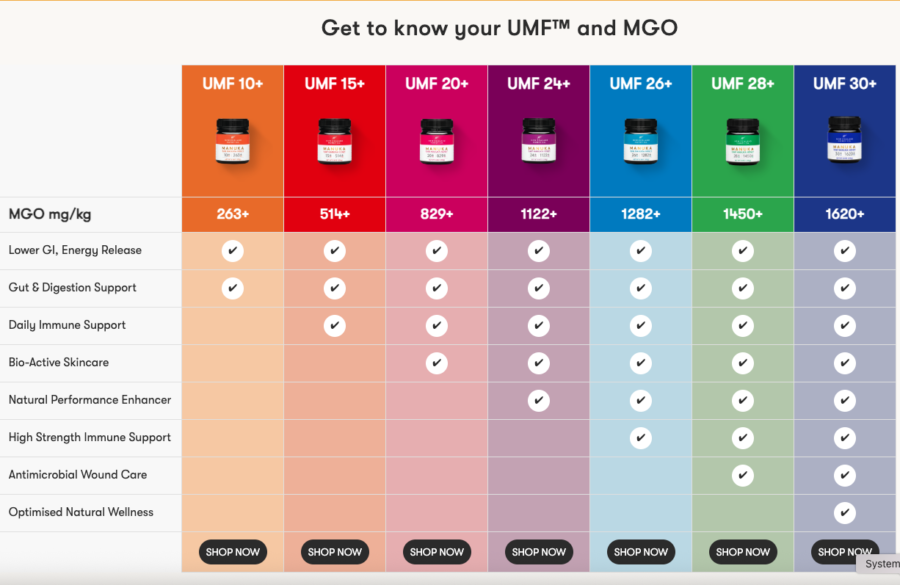
UMF and MGO Ratings of New Zealand Honey Co. honey. UMF 10+ to 30+ and MGO 263+ to 1620+
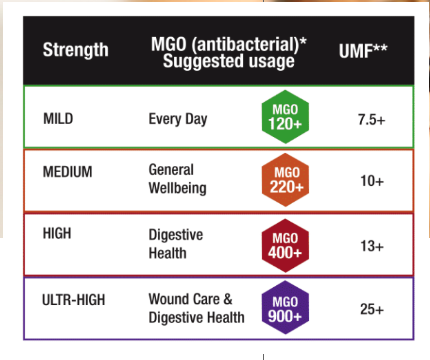
Not only is Manuka Honey unique to the world of honey but there is a whole world within this type of honey, itself. First of all, there are mono floral and multi floral Manukah honeys. Then, there are specific antibacterial strengths (MGO) with various certification levels (UMF). See charts above and below.
Berringame Grading System
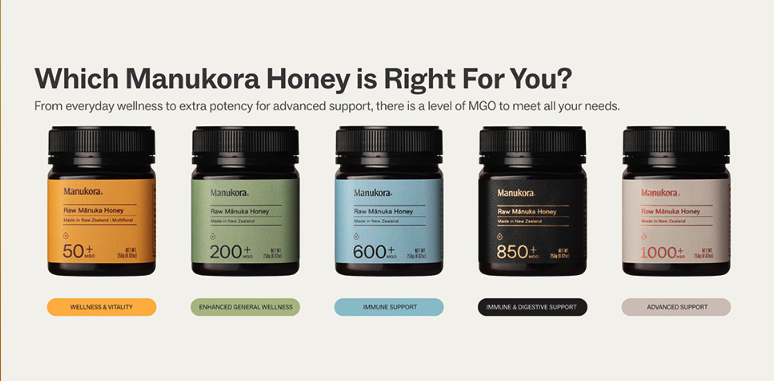
“Mānuka honey contains 3x the natural antioxidants vs regular honey, many that you can’t find elsewhere. Antioxidants have been studied to help balance the body’s inflammatory response.” Manukora Honey Manukora Honey 50+ MGO to 1000+ MGO
WELLNESS OR MEDICINAL GRADE MANUKA HONEY
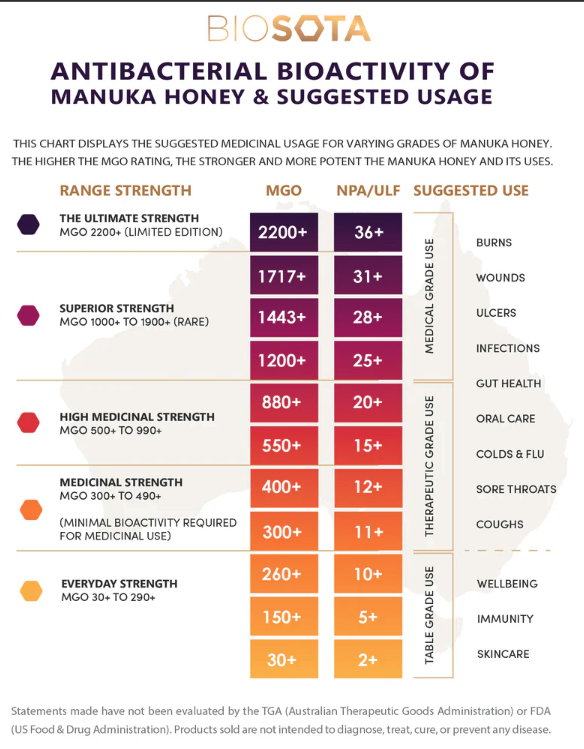
To begin with researching what grade of Manuka honey to purchase, it is important to determine the main purpose of your purchase, wellness or medical. See the chart below for details.
Manuka Honey and Suggested Uses from Bisota Manuka Honey
MANUKA HONEY RATING SYSTEMS
MGO 263+ to 1620+ “More MGO = more of the good stuff!
MGO, is a unique antibacterial compound naturally found in the nectar of the Mānuka tea tree flower. A higher MGO number means higher antibacterial activity and also higher concentrations of other key bioactives.” Manukora Honey Company
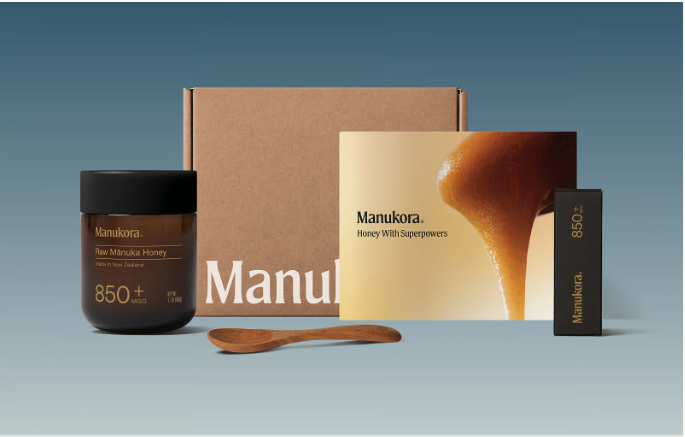
Winter Reset Mānuka Kit 850+ MGO
UMF 10+ to 30+ This is the official rating system, known as the Unique Manuka Factor, with a minimum is 10+, and a maximum is 30+. It is independent of any single brand, trusted by premium Manuka honey producers that test genuine, fresh, pure, raw, and monofloral Manuka honey produced and packaged in New Zealand. The gold standard of Manuka honey is UMF™ 1620+.
At this rating, one is covering all the bases and getting the best possible product straight from the wilds of New Zealand. “UMF™ was created by an independent organisation, the Unique Manuka Factor Honey Association. It verifies genuine Manuka honey, its antibacterial potency, and its freshness. Only monofloral Manuka honey can receive a UMF™ grade.”
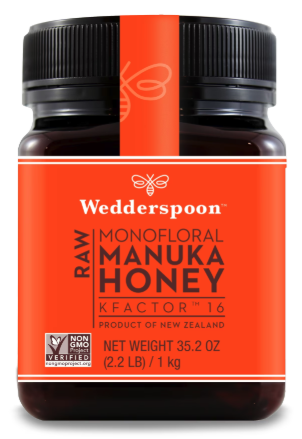
Wedderspoon K FACTOR HONEY
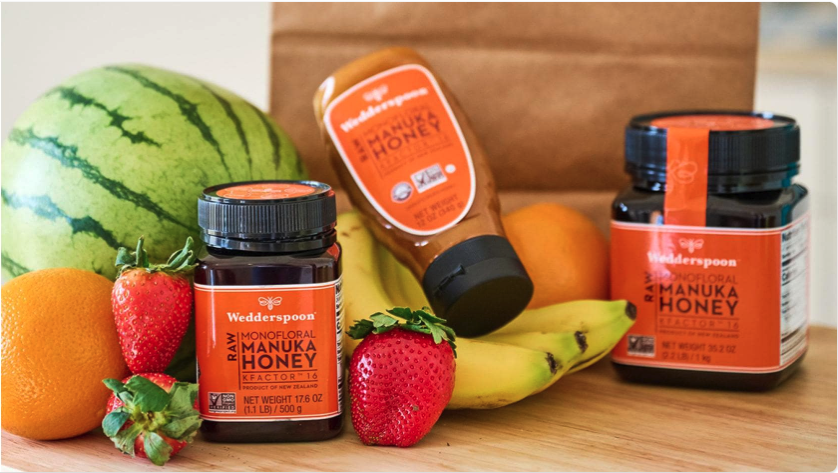
“KFactor™ is a Manuka honey rating system created by a honey brand, Wedderspoon Raw Mono Floral Honey. It verifies five key factors which indicate genuine Manuka honey: traceability, raw and unpasteurized, non-GMO, made in New Zealand, and free from antibiotics, glyphosate, and pesticides. KFactor™ can be multifloral or monofloral.
“KFactor™ leaves out one of the most critical measures that most Manuka honey customers look for – its antibacterial potency. Methylglyoxal (MGO) content is not included in the KFactor™ rating. Instead, we recommend the UMF™ rating for Manuka honey.” New Zealand Honey Co.
MOST POPULAR BY POTENCY AND HONEY COST
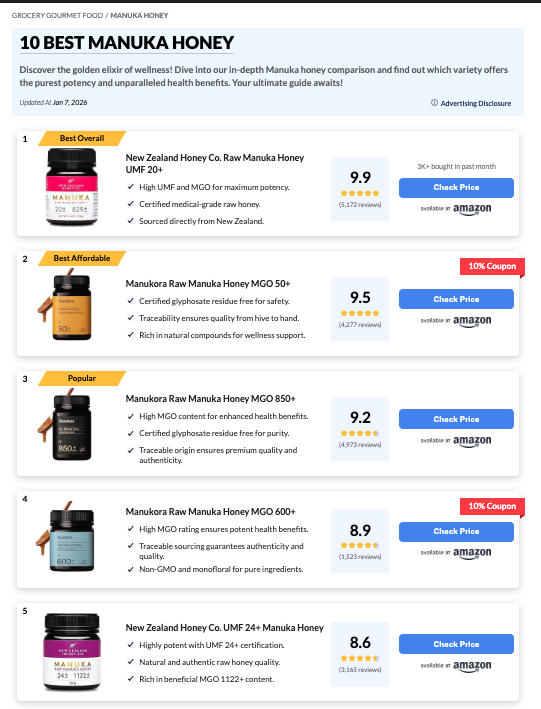
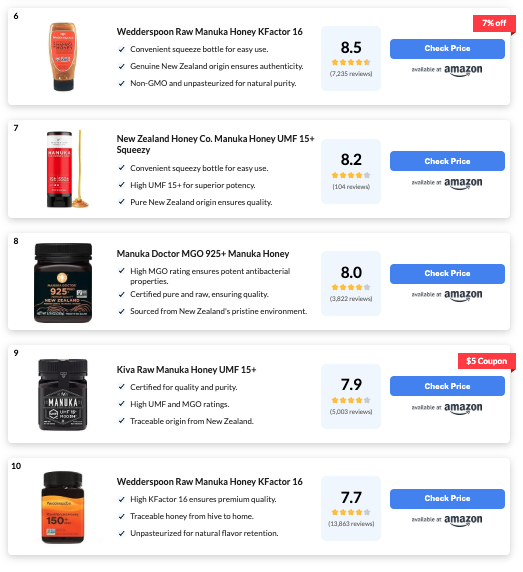
Below is a suggested listing of the 10 most popular Manuka honeys. Top ten suggested brands of Manuka Honey (1-5)Top 10 brands of Manuka honey (6-10)
COMPARING BRANDS: KEEP THIS IN MIND
Comparing Manuka honeys brands can be confusing. In fact, it is a bit like going to buy a mattress. Each retailer has a different name for the same mattress manufacturer. So it is almost impossible to compare them by firmness and cost. This is similar to Manuka Honey Ratings:
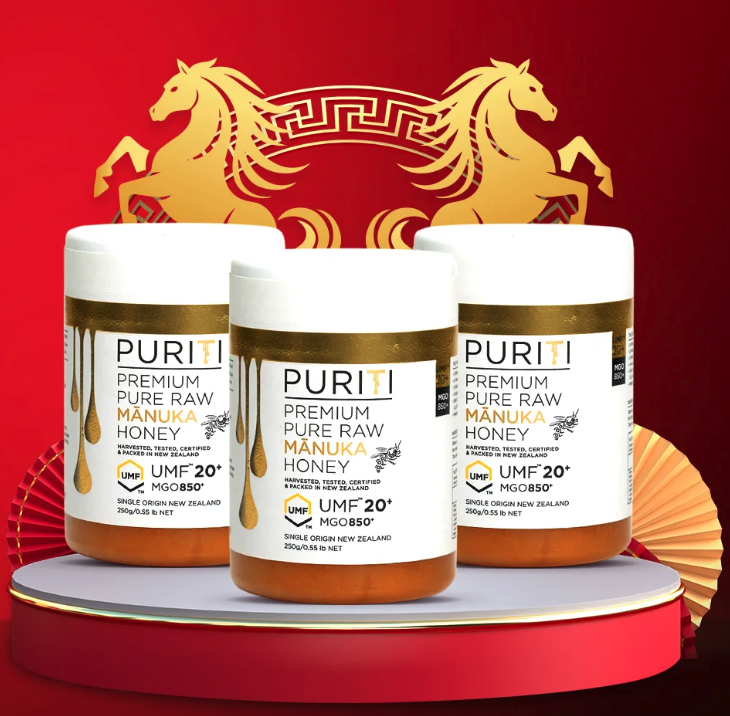
• Some honeys list both the UMF+ factor and the MGO+ factor. The New Zealand Honey Company has both. So does Puriti Premium Honey UMF+/MGO+.
Puriti Premium Honey UMF 20+/MGO 850+
• Some rate by the UMF+ rating. “UMF™ was created by an independent organisation, the Unique Manuka Factor Honey Association. It verifies genuine Manuka honey, its antibacterial potency, and its freshness. Only Mono Floral Manuka honey can receive a UMF™ grade.” The New Zealand Honey Company.
• Some honeys list only the MGO+ factor. Is higher MGO better in Manuka honey?
Higher MGO ratings are better if you want more antibacterial activity in your Manuka honey. If you only want a daily dose of goodness from your honey, then lower MGO ratings are fine. Manukora Honey lists only the MGO+ rating.
• “KFactor™ was created by a honey brand to promote their products, and tests for five factors that indicate quality Manuka honey, but don’t say anything about its potency. KFactor™ Manuka honey can be multifloral (made from a combination of different nectars) or monofloral (made mostly from mānuka nectar).” New Zealand Manuka Honey Company.
Wedderspoon Raw Monofloral Manuka K FACTOR Honey
A final thought or is it? You may select or have a recommendation for a Manuka honey based in UMF+ and MGO+ data. But then there is still the cost to be considered. That is the cost itself and by the size of the jar. What is affordable for you? Here’s where common sense, budget, and bookkeeping comes into play.
My suggestion is to start smart. Buy a small jar first whenever possible. The New Zealand Honey Company makes this very easy to do with its step up variety of sizes for all their UMF+/MGO+ rated Manuka Honeys. Their honey starts with a 4.4 oz jar. You can always go bigger with their honey once you find the strength that works for you and the taste you like. Unless there is a great sale on a larger size, I suggest starting with a small jar first.
A Personal Note
I prefer to use nature’s remedies to treat and heal imbalances in my body whenever possible. In spite of this, I am not a medical professional. Therefore I can only share my own experience rather than prescribe natural medicine as a substitute for medical attention.